Showing posts with label National Gun News. Show all posts

Monday, November 24, 2014

The 3 Main Rules of Firearm Safety & Why They're Important


At Central Guns and Ammo, we teach many firearm safety courses, and while there are many rules of firearm safety, three are of paramount importance and must be followed at all times.

When followed, these three rules will prevent negligent discharges. If a negligent discharge does happen, no one will get hurt. These three rules were created by the National Rifle Association.

1. Always Keep the Muzzle Pointed in a Safe Direction: Up, Down, or Away.

This is the first rule of firearm safety. You are responsible for the bullet when it leaves the barrel. It basically has your name on it. The reason it is so critical is because if a firearm discharges and it is pointed in a safe direction, no harm will come to pass.

Depending on where you are, safe directions to aim the firearm include up in the air, down at the ground, and away from people or anything of value.

2. Always Keep a Firearm Unloaded Until Ready to Use.

In addition to always keeping a firearm unloaded until you are ready to use it, always check the action to confirm it is unloaded when picking it up or receiving it from another person. This is true even if the firearm is brand new in the box from the manufacturer. After verifying the firearm is unloaded, the person handling it should always treat it as if it is loaded.

3. Never Put Your Finger on the Trigger Until You are Ready to Shoot.

While there have certainly been documented incidents where firearm accidents occurred even though no one pulled the trigger, negligent discharges mostly occur because someone pulled the trigger by mistake.

Eliminate that possibility by never placing a finger on the trigger -- meaning do not have a finger inside the trigger guard -- unless planning to fire the firearm.

Other Rules to Keep in Mind:

By extension of these three rules, all other errors associated with firearms are eliminated. For example, a general rule of firearms is never point a firearm at another person unless you intend to fire at them. This rule could easily replace rule number two, -- and there is nothing wrong with considering it a cardinal rule -- but the notion follows logically from the rule: always point a firearm in a safe direction.

Another rule of firearms is always keep the safety on, -- even if a firearm is empty -- but eliminating one of the three cardinal rules with this one opens the door for mistakes that the other rules prevent. As such, always keep a firearm unloaded until you are ready to use it. The safety is a mechanical device which can fail, so the person handling the firearms should always act as if the safety doesn’t work.

Key Takeaway:

If a person always treats a firearm as if it's loaded, never points a firearm at another person, and keeps their finger off the trigger until they are ready to shoot, virtually all potential negligent discharges are eliminated.

Monday, November 17, 2014

More than six in 10 Americans say guns make homes safer

(Originally posted by Gallup)

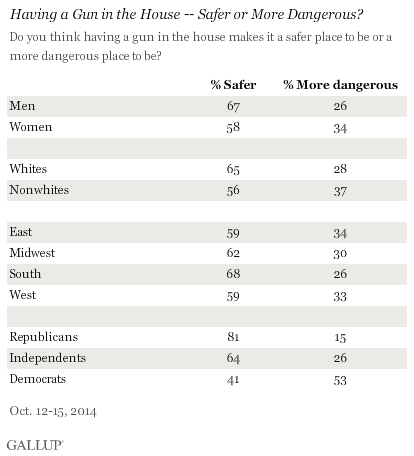
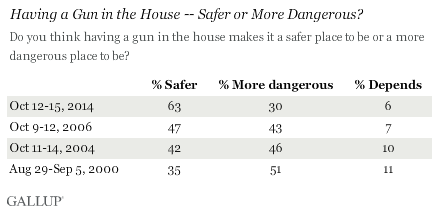
The percentage of Americans who believe having a gun in the house makes it a safer place to be (63%) has nearly doubled since 2000, when about one in three agreed with this. Three in 10 Americans say having a gun in the house makes it a more dangerous place.
Having a Gun in the House -- Safer or More Dangerous?
Gallup originally asked Americans about their views on the implications of having a gun in the home in 1993, and then updated the measure in 2000. Between 2000 and 2006, less than half of Americans believed having a gun at home makes it safer -- but since then, this percentage has significantly increased to a majority.
Republicans (81%) are about twice as likely as Democrats (41%) to believe having a gun improves home safety. About half of Democrats say having a gun makes a home a more dangerous place to be.
Although there is a gender gap in the results for this question, majorities of both men (67%) and women (58%) believe having a gun improves home safety. While one in three women say it makes for a more dangerous place to be, only one in four men say the same about guns in the home.
About two-thirds of whites and Southerners endorse having a gun to improve home safety, as do majorities of nonwhites (56%) and residents of the other three regions.
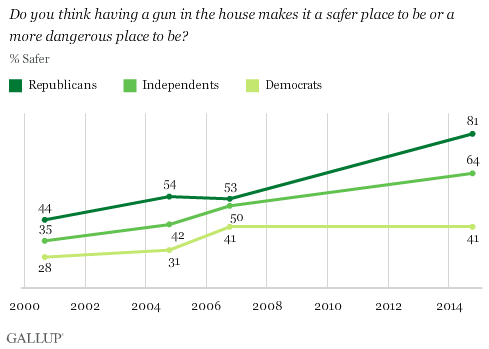
Having a Gun in the House -- Safer or More Dangerous?
Since 2000, Americans of all political stripes have become more inclined to believe a gun makes a home more secure. But the rate of increase has been greatest among Republicans, with 81% now holding this position, up from 44% in 2000.
While those who identify with the GOP have seen a 37-percentage-point growth in this sense of safety, independents show a 29-point climb and Democrats show a 13-point increase.
Do you think having a gun in the house makes it a safer place to be or a more dangerous place to be?
More Than Four in 10 Americans Keep a Gun in Their Home
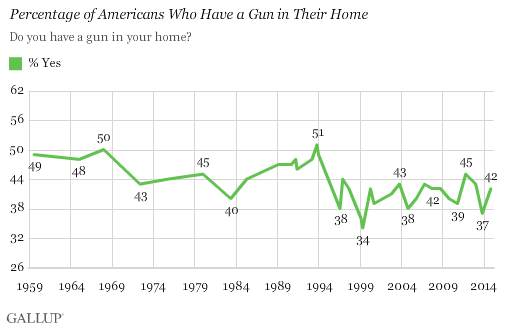
Forty-two percent of Americans report having a gun in their home, similar to the average reported to Gallup over the past decade. This self-reported measure has fluctuated from survey to survey, but is consistent with trends since 2004. Longer term, Gallup has found that household gun ownership has ranged from a low of 34% in 1999 to a high of 51% in 1993.
Percentage of Americans Who Have a Gun in Their Home
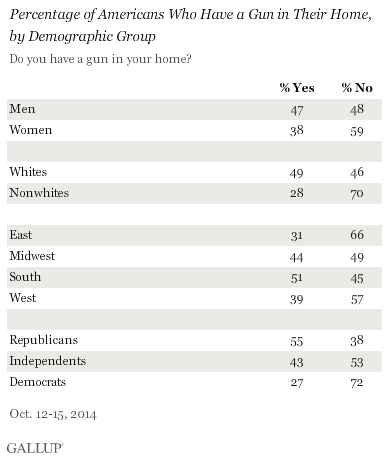
Republicans are twice as likely as Democrats to have a gun in their house. A majority of Southerners say there is a gun in their home, much higher than the rate among those in the West and East.
Men are about equally as likely to have or not have a gun at home. About six in 10 women say they do not have a gun in the home.
Percentage of Americans Who Have a Gun in Their Home, by Demographic Group
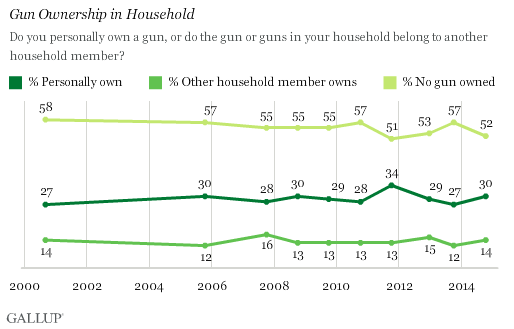
Most survey respondents report that the gun in their household belongs to them personally (30%), as opposed to another household member (14%). This means that about one in three people who have a gun in their home are not personally owners, but are aware the gun is there. The personal ownership trend has been generally stable over the past 13 years.
Gun Ownership in Household
Americans who have a gun in their household are significantly more likely than others to say that having a gun makes a home safer (86%), though one in 10 believe it makes a household more dangerous.
Bottom Line
While Gallup figures on U.S. gun ownership have not shifted much since 2006, the percentage of Americans who say that having a gun in the home makes that household safer has drastically climbed over the past eight years.
Americans own guns for a wide array of reasons, but the increase in the perceived safety value of owning them suggests that guns are taking on more of a protective role than they have in the past. Florida passed the nation's first "Stand Your Ground" law in 2005, followed by dozens of states that passed different versions of the law. In the decade since, Americans have become more likely to view guns as a means of self-protection.
Regardless of Americans' perceptions of crime and their need to protect themselves, violent crime rates fell significantly from 1993 to 2012. While it may be a contentious assertion, some attribute falling crime rates to increased gun sales.


What do you think? Are homes safer with firearm protection? Would you feel less secure if you did not have firearms in your possession?

Friday, September 26, 2014

Hawaii: Federal Court Ruling Overturns Certain Firearm Permit Laws

(Originally posted by NRA-ILA)

Last week, a federal judge overturned Hawaii’s current law which bars legal immigrants from applying for a firearm permit. This ruling came after an Australian citizen, who is a permanent resident living in Honolulu, filed for relief from state laws restricting him from obtaining a firearm permit.
The judge ruled that the discriminatory state law prohibiting legal immigrants from applying for a firearm permit violated the equal protection clause of the U.S. Constitution. Allowing lawful permanent residents, in addition to U.S. citizens, to apply for a firearms license will open the door for law-abiding individuals to exercise the guarantees of the Second Amendment in Hawaii.
This is the latest in a string of court rulings across the country overturning similar laws and is good news for individuals legally and permanently residing in the United States.

Friday, September 12, 2014

Missouri Lowers Concealed Carry Age Limit to 19

Originally seen on CBS

Prospective gun owners in Missouri will be able to apply for conceal-and-carry permits at an earlier age after a bill was passed in both the House and Senate. The bill lowers the age to apply for a conceal-and-carry permit from 21 to 19. It also prohibits cities from banning open carry laws and allows teachers and school administrators acting as school protection officers to carry firearms.
Sen. Will Kraus, R-Jackson County, sponsored the bill. During the Sept. 10 veto session, Kraus said the purpose of the bill was to protect the rights of gun owners who have earned the open-carry privilege. According to Sen. Jolie Justus, D-Jackson County, the open-carry option is detrimental to Kansas City.
“We have a culture where, unfortunately, for whatever reason, people are killing people with guns,” Justus said. “It just sends a message that my city doesn’t want.”
Other concers regarding the bill incuded Missouri’s trend of lowering the age needed to obtain conceal-carry permits. Justus said younger minds haven’t fully developed and don’t have the same decision-making capabilities as young minds. According to Kraus, a young person’s ability to serve their country in combat and vote earns them the right to carry firearms.
The possibility of guns on school campuses also became an issue of concern on the Senate Floor. Justus said she feared the potential risk involved with arming school teachers and administrators.
The bill would require teachers and other administrators to receive training before being allowed on school property with firearms.
“If you do identify school protection officers, they have to go through POST training,” Kraus said. “Once again, this doesn’t mandate schools doing this, it’s an option.”
According to the Department of Public Safety, Peace Officer Standards and Training, or POST, regulates the licensing of peace officers.
Justus said she was not convinced these provisions addressed the issue at hand.
“More guns cannot possibly help this situation, in my belief,” Justus said.
The bill was originally vetoed by Gov. Jay Nixon in July 2014. It passed in the Senate on a straight party-line vote of 23-8, but passed the House by a bipartisan vote of 117-39.
With the House vote, the bill now becomes law.


What do you think about lowering the concealed carry age from 21 to 19? Here in Hawaii, we do not have a concealed carry permit available, but would you want to see one implemented? Would a concealed carry permit lead to an increase in safety in the community?

Thursday, July 17, 2014

Obama Administration bans the import of Saiga firearms

According to The Truth About Guns, "the Department of Commerce announced new sanctions against Russian products and companies operating in the United States. Previous sanctions only tangentially impacted the import of cheap and reliable firearms from Russia into the United States, but now the Obama administration is specifically targeting the makers of Saiga rifles and shotguns, as well as other companies. From the Executive Order...

The following entities have been added to OFAC’s SDN List:
[...]
KALASHNIKOV CONCERN (a.k.a. CONCERN KALASHNIKOV; a.k.a. IZHEVSKIY MASHINOSTROITEL’NYI ZAVOD OAO; f.k.a. IZHMASH R&D CENTER; f.k.a. JSC NPO IZHMASH; f.k.a. NPO IZHMASH OAO; a.k.a. OJSC CONCERN KALASHNIKOV; f.k.a. OJSC IZHMASH; f.k.a. SCIENTIFIC PRODUCTION ASSOCIATION IZHMASH JOINT STOCK COMPANY), 3, Derjabin Pr., Izhevsk, Udmurt Republic 426006, Russia; Registration ID 1111832003018 [UKRAINE2].
So the importation of new Izmash-produced firearms is now banned indefinitely in the United States. But that executive order definitely raises some questions for those currently in possession of a firearm manufactured by the now-sanctioned firearms companies. For example, can a gun dealer sell their existing stock? From the FAQ regarding the legality of items already in the United States:
374. If I own a Kalashnikov product, is that product blocked by sanctions? Am I able to resell a Kalashnikov product at a gun show or other secondary market?
If a U.S. person is in possession of a Kalashnikov Concern product that was bought and fully paid for prior to the date of designation (i.e., no payment remains due to Kalashnikov Concern), then that product is not blocked and OFAC sanctions would not prohibit the U.S. person from keeping or selling the product in the secondary market, so long as Kalashnikov Concern has no interest in the transaction. New transactions by U.S. persons with Kalashnikov Concern are prohibited, however, and any property in which Kalashnikov Concern has an interest is blocked pursuant to OFAC’s designation of Kalashnikov Concern on July 16, 2014. If a U.S. person has an inventory of Kalashnikov Concern products in which Kalashnikov Concern has an interest (for example, the products are not fully paid for or are being sold on consignment), we advise that U.S. person to contact OFAC for further guidance on handling of the inventory. [7-16-2014]

375. If I have Kalashnikov products in my inventory, can I sell them?
If a U.S. person has an inventory of Kalashnikov Concern products in which Kalashnikov Concern has an interest (for example, the products are not fully paid for or are being sold on consignment), we advise that U.S. person to contact OFAC for further guidance on handling of the inventory. [7-16-2014]
We all saw this coming, but the reality is always more confusing and distasteful than the perception. There is no word at this time whether additional Russian firearms related manufacturers will get the same treatment."

What are your thoughts on this?